


Why partnership with the VCSE sector is essential for neighbourhood health
Across the UK, health and care systems are under pressure. Increasing numbers of people are living in ill health, and healthy-life expectancy has fallen. In some areas, people can now expect to live only 55 years in good health. The impact of this is felt by individuals, across communities, the NHS, social care, other public services, and the wider economy. In response, policymakers have turned to the idea of neighbourhood health.
Neighbourhood health can mean different things to different people. For some it is about integrating services locally. This is important, and central to the government’s Neighbourhood Health Framework, but solely focusing on this overlooks a crucial part of the picture. Health is not created by services alone. It is created when people’s circumstances mean they can look after themselves and their loved ones. And it is created in communities, when people come together to share activities, learn new things, care for others or simply spend time together.
The relationships formed through this strengthen our bonds as a community, and this community power helps people connect, find or create the things they want or need, increasing a sense of belonging, reducing loneliness and isolation, and strengthening civic resilience. Sometimes this happens informally – between neighbours, friends or around schools, faith groups, sports clubs, cafés, pubs or other community spaces. Sometimes it grows into something more formal, such as community groups, charities or social enterprises.
Together, alongside personal relationships and informal networks, these organisations - often called the voluntary, community and social enterprise (VCSE) sector or microbiome - form essential community infrastructure that underpins neighbourhood health. This plays a vital role in supporting people, creating the conditions for healthy communities and changing how systems understand and share power and invest in communities.
The role and value of VCSE organisations in neighbourhood health
Supporting people
1. Services and specialist support
Providing health, care, wellbeing and other forms of support, including specialist help for people with particular conditions, experiences, identities or circumstances.
2. Early help and prevention
Reaching people earlier, helping to prevent problems developing or escalating, and supporting people to stay well, independent and connected for longer.
3. Practical support and advocacy
Helping people address the practical issues that affect their health and wellbeing, such as money, housing, food, transport and daily living, while also supporting them to navigate services, understand their rights, have their voices heard and get the help they need.
4. Trusted relationships
Building and sustaining relationships over time, including with people and communities who may not engage with, trust or be well served by statutory services.
5. Understanding people in the context of their lives
Seeing people as whole human beings and understanding their health and wellbeing in the context of their relationships, circumstances, communities and the wider conditions affecting their lives.
Creating healthier communities
6. Creating health and wellbeing
Creating the everyday conditions that help people live healthier, happier and more connected lives through relationships, belonging, purpose, participation, physical activity, creativity, nature, mutual support and access to community life.
7. Community assets and infrastructure
Providing and nurturing the places, organisations, groups, networks, activities and community infrastructure that people rely on for connection, support, participation and wellbeing.
8. Community capacity, leadership and power
Strengthening the confidence, skills, relationships, local leadership and collective capacity within communities so that people can act on their own priorities, develop their own solutions and have greater influence over decisions that affect them.
9. Connection and social capital
Building relationships and connections between people, strengthening mutual support and trust, and creating the social networks that help individuals and communities become more resilient, resourceful and able to act together.
Changing systems
10. Community voice, power and influence
Ensuring that communities can shape priorities, decisions, services and investment, rather than simply being consulted about plans that have already been made.
11. Community insight and intelligence
Bringing deep knowledge of people’s lives, experiences, strengths and unmet needs into planning and decision-making, identifying emerging issues early and helping services understand what conventional data alone cannot show.
12. Engagement and co-production expertise
Knowing how to reach, listen to and work alongside different communities in inclusive and meaningful ways, and helping people with lived experience to play a genuine role in designing solutions, services and strategies.
13. Connecting communities, organisations and systems
Building bridges between residents, community groups, VCSE organisations and public services, helping different parts of a place work together and making it easier for people, knowledge, relationships and resources to flow across organisational boundaries.
14. Bringing people, resources and investment
Contributing a substantial workforce of paid staff, volunteers, peer supporters and people with lived experience, while also bringing charitable income, fundraising, grants, assets, expertise and other resources that add to what the public sector can provide.
Many VCSE organisations have been around for a long time - in some cases longer than the NHS itself. They bring significant expertise and capacity, including a professional paid workforce, armies of volunteers, and access to sources of funding from outside the public sector.
Facts and figures
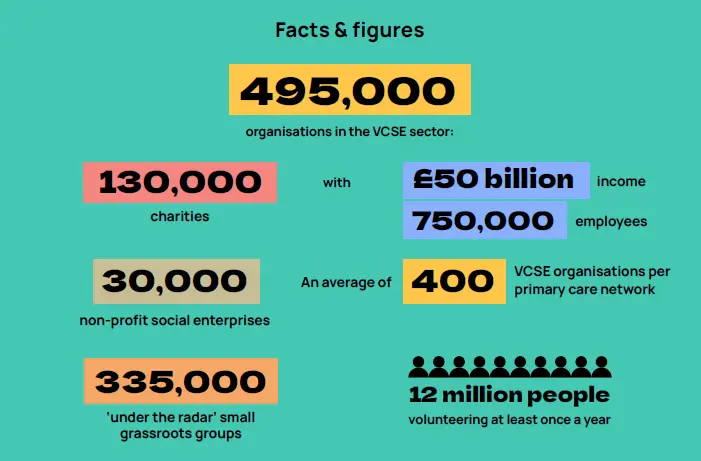
Free from complex bureaucracy, VCSE organisations often have the advantage of being agile and dynamic in how they operate. They can quickly change what they are doing and how they work as long as they remain responsive to the people they support and what they were set up to do. Many VCSE organisations are part of wider networks - locally, regionally, nationally and sometimes internationally - enabling them to share learning and bring innovation into local systems. Collaboration and partnership working is often the default way of working.
In some communities, where people have less money and free time outside of work, it can be harder to get things started in the community and keep them going. That’s why some VCSE organisations support community building activity and help other VCSE organisations navigate how to grow and expand the work they are doing.
There is evidence to show that connections, activities, organisations, networks and alliances, formed by the community for the community - rather than by the public sector or through private enterprise - help make more inclusive, safe and supportive communities and services for all. They do this, in part, by reducing the barriers to community life, support and opportunities that some people face due to isolation, exclusion, discrimination, poor health or difficult life circumstances.
When people and communities are better able to shape what is happening in their lives and communities, and can access suitable support, this can strengthen wellbeing, build resilience and help prevent avoidable health crises and escalation of need. This in turn can reduce demand on the NHS and public services, allowing them to focus on those that need them most.
All this combined makes VCSE organisations an essential part of neighbourhood health. It is also part of the original imaginings of the NHS, with clinicians working alongside existing community organisations and the formal voluntary sector. As Beveridge said, the NHS was “never meant to go it alone”.
NAVCA and ALLiance42, with the support of The Partner Ship, we have been working to bring together VCSE evidence, solutions and learning to answer practical questions about how to deliver neighbourhood health with communities. This is shared in the VCSE Handbook on Neighbourhood Health. They would love to hear your feedback and about your experiences and examples of where VCSE partnership is supporting neighbourhood health so please feel free to get in touch with them at:
Important news

Why partnership with the VCSE sector is essential for neighbourhood health
NHS Patient Entrepreneur Programme
Funding Opportunity: Pathways to Work Innovation Fund
Opportunity: Independent Chair

Unlocking neighbourhood data

London Neighbourhood Health modelling
Get the latest south east London Alliance updates straight to your inbox
Join our growing community of VCSE organisations and statutory partners to hear about the latest resources, events, training and opportunities to get involved in strategic collaboration to drive change.